
Only one insurance claim in 11 years of "Ignitis ON" EV race: how losses are avoided and how the EV insurance market is changing
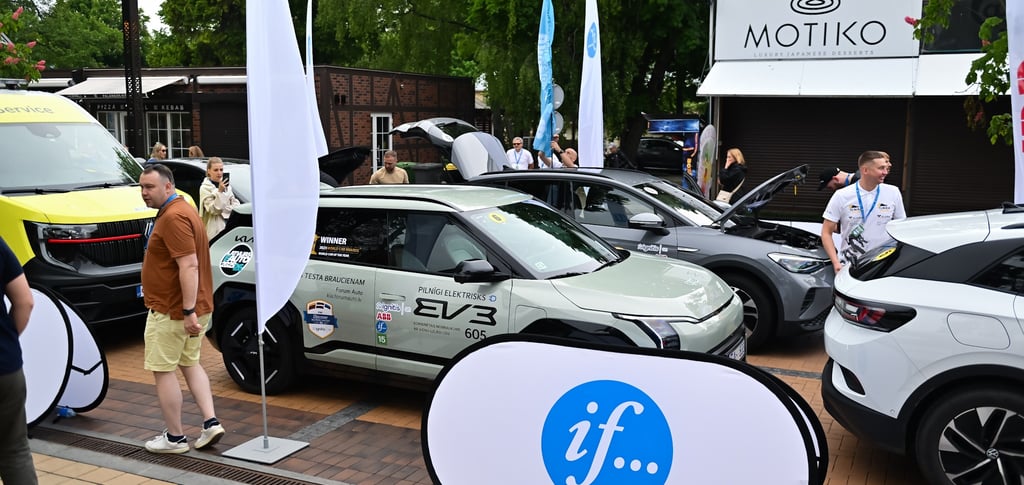
On June 12, 2026, the traditional "Ignitis ON" electric vehicle race will kick off at Kaunas "Science Island". In 2015, only 10 electric cars started the race, while last year, 64 teams gathered at the start. This year, the organiz-ers will welcome 70 teams, which must reach the "Ahhaa" Science Centre in Tartu in a single day, with a stop at the "Space Education Centre" in Cēsis along the way. Participants will cover over 500 km, and organizers expect all cars to successfully reach the finish line. Over 11 years, only one insurance claim has been recorded, and even that did not happen on the road – a charging socket was damaged while pulling out a charging connector. Accord-ing to the event organizers, such successful statistics are due to one very important factor – impeccable compli-ance with traffic rules. All electric vehicles in the race are tracked by two automatic systems, and recorded viola-tions are strictly penalized.
4/20/20264 min read
Since the very first race, participants have mostly discussed two issues – the range per charge and the cost of insurance. The range of new models increases every year, while insurance prices still spark sharp debates. We spoke about trends in the EV market with Diana Koloskovienė, Head of Motor Product Risk Management at "If" insurance.
- Why is EV insurance still more expensive than for conventional cars?
- CASCO insurance for electric vehicles is still often more expensive than for conventional internal combustion engine (petrol or diesel) cars. The main reason is high repair costs, especially if the battery is damaged. An EV battery is one of its most expensive and complex parts. If it is damaged, repairing it is no longer safe and is usually not recommended by the manufacturer – so it is generally recommended to replace the battery with a new one. In such cases, repairs can cost so much that the insurance company often declares the car a total loss and pays out an insurance sum close to the value of the car itself. In 2025, the most common range for the largest claims paid out was 20–22 thousand euros.
- Does the EV insurance market in the Baltic States differ significantly?
- Looking at the share of EVs in the Baltics, it is clear that all three countries are moving at a similar pace. According to data from the beginning of this year 25,195 pure electric vehicles, or BEVs (passenger cars and light commercial vehicles up to 3.5 t), were registered in Lithuania. They account for about 1.3% of all such vehicles in Lithuania. In Estonia, the share of pure EVs is slightly higher at 1.5%, while in Latvia, it reaches 1.6%. Thus, the differences are not large, but in absolute numbers, Lithuania is already ahead of its Baltic neighbors.
This context is also important for the insurance market, as the share and quantity of EVs directly affect insurance products, the nature of claims, and prices. The more EVs enter the market, the more the insurance market adapts to their specific risks – more expensive repairs, more complex parts supply, specific battery damage issues, and so on.
Our data shows another clear trend: in all three Baltic countries, the share of currently active CASCO policies for EV passenger cars and light commercial vehicles is about 4%. This is significantly higher than the overall ratio of pure EVs in the Baltic vehicle market. This difference is driven by several factors.
First, a specialized CASCO product for EVs is offered, which covers risks specifically important to EV owners – for example, charging equipment protection, breakdown assistance, towing the car where needed, and similar services. Second, the insurance company purposefully focuses on the EV segment – paying significant attention to the growing EV market, expanding insurance terms and pricing relevant specifically to this category. Third, EVs are often more expensive than the average petrol or diesel car, so their owners more frequently choose CASCO insurance, especially if the vehicle is leased. This automatically increases the share of pure EVs in our portfolio. Finally, EV drivers, as early adopters of this technology, are more inclined to choose broader insurance coverage and are often better informed about potential risks. This consumer group naturally forms a higher ratio of insured electric vehicles.
- Are insurance companies equally evaluating European, American, or Chinese EVs when assessing risks?
- We do not categorize EVs by their origin. We assess them based on the car's brand, class, value, repair complexity, and cost. For example, Tesla is generally considered a luxury segment car, so its claims and insurance premiums are naturally higher. European models more often fall into the economy or middle class, so their risk indicators are typically lower. For Chinese manufacturers' cars, there is currently more uncertainty regarding repair options and the supply of spare parts. However, once this area stabilizes, we will evaluate them exactly the same as any other cars.
- Predict the future of the EV insurance market. Where can we expect price decreases, or is an increase forecasted?
- In the future, EV insurance prices will mostly depend on how quickly the popularity of specific models grows and how their repair capabilities, the used car market, and manufacturers' repair policies develop. The more cars of a certain model there are on the market and the better their service infrastructure is developed, the more accurately insurers will be able to predict potential risks, which usually means lower insurance premiums. Therefore, average CASCO insurance prices for widely used EVs should decrease over time. A larger number of such cars on the market allows for the accumulation of more claims history, and clearer, more established repair processes reduce costs. This will also be supported by a larger supply of spare parts and faster delivery, which will reduce additional costs, such as those related to how long a person needs a replacement car. Meanwhile, very expensive, rare, or technically complex EVs will likely remain in a higher-risk category. Their insurance prices may continue to be driven up by more expensive parts, a smaller number of specialized service centers, longer repair times, and less accumulated data on such types of claims.
- When will EV insurance be cheaper than for diesel or petrol cars?
- EV insurance will become cheaper than petrol and diesel car insurance when EVs become a widely used, easily serviced, and highly predictable product. Additionally, there are insights that when a driver switches to a newer car or an EV, more incidents may occur initially. Therefore, we recommend properly assessing your driving capabilities and, after changing cars, driving even more attentively, at least in the beginning.